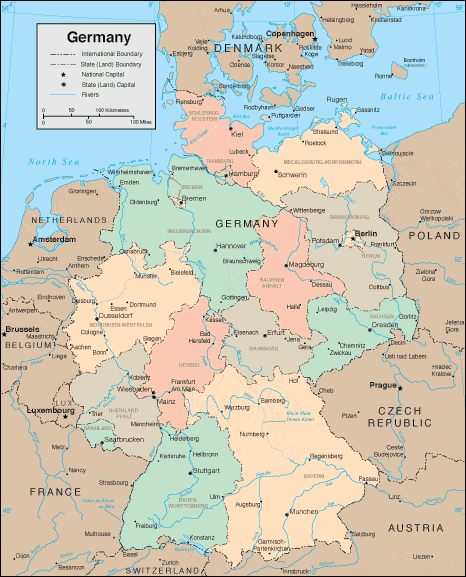
| Population: | 80,457,737 (July 2018 estimate) |
| Size: | 357,022 sq km (slightly smaller than the US State of Montana) |
| Bordering countries: | Austria, Belgium, Czech Republic, Denmark, France, Luxembourg, Netherlands, Poland, Switzerland |
| Coastline: | 2,389 km • Forests and woodland cover 31% of the country |
| Climate: | temperate and marine; cool, cloudy, wet winters and summers; occasional warm, occasional warm, mountain (föhn) wind; high relative humidity |
| Lowest point: | Neuendorf bei Wilster (-3.54 m) |
| Highest point: | Zugspitze (2,963 m) |
| Life expectancy at birth: | 78.6 for males, 83.4 for females (2018 estimate) |
| Religions: | Protestant 27%, Roman Catholic 29%, Muslim 4.4%, unaffiliated or other 39.6% |
| Government type: | federal parliamentary republic |
| National capital: | Berlin |
| Voting Age: | 18 |
| States: | Baden-Württemberg, Bayern, Berlin, Brandenburg, Bremen, Hamburg, Hessen, Mecklenburg-Vorpommern, Niedersachsen, Nordrhein-Westfalen, Rheinland-Pfalz, Saarland, Sachsen, Sachsen-Anhalt, Schleswig-Holstein, Thüringen |
| Major Political parties: | Christian Democratic Union (CDU), Christian Social Union (CSU), Free Democratic Party (FDP), Social Democratic Party (SPD), Alliance 90/Greens, Left Party (Die Linke), Alternative for Germany (AfD) |
| Currency: | 1 euro (€) = 100 cents |
| Telephones: | 44.4 million land lines 2017 – 106 million mobile subscribers 2017 |
| Internet users : | 72.365 million (2016) – 33.221 broadband subscribers 2017 |
| Railways: | 43,468.3 km of track |
| Waterways: | 7,467km |
| Airports (Total of all large and small airports with both paved and unpaved runways): | 539 |
| Heliports: | 23 |
| Roadways: | 645,000 kilometers (12,800 km Autobahn) – includes local roads |
(Source: CIA Fact Book)
Number of residents in Germany from English-speaking nations as of 31 December 2017, not including members of the military:
| USA | 117,730 |
| Great Britain | 116,465 |
| India | 108,965 |
| Pakistan | 73,000 |
| Canada | 17,505 |
| Australia/New Zealand | 15,812 |
| Ireland | 17,560 |
| South Africa | 6,090 |
(Source: Statistisches Bundesamt in Wiesbaden)