
At the German Post Office, you can do a lot more than just mail letters.
In 1989 the government-run Deutsche Bundespost, which included the Deutsche Bundespost Postdienst, Deutsche Bundespost Postbank and Deutsche Bundespost Telekom was broken up into three parts and set on the path to privatization. By 2005 the privatization of the Post Office was complete when the Deutsche Post AG went public with an IPO. (The former Postbank is now Deutsche Postbank AG and the telephone company is Deutsche Telekom AG)
In 2004 the Deutsche Post AG acquired DHL International. Now called Deutsche Post DHL Group, the new acquisition is responsible for the delivery of express mail, packages and parcels and other services in Germany as well as operating the former DHL business worldwide. This is why the Deutsche Post and DHL logos adorn all the post offices in Germany and why it is common to see DHL trucks on the roads and streets in Germany.
While there are still dedicated post office branches in most German cities, under the new regime the neighborhood post office is often a sort of one-stop shopping center. It could be part of a stationery or grocery store with a section or counter where you can buy stamps, mail a package, deposit or withdraw money and apply for a credit card. It will also probably be open more convenient hours than the bureaucratic post offices of old.
And that’s only the part that is visible to the average consumer. As the name “Deutsche Post DHL” implies, the new company is a major world player in the growing field of logistics. It has streamlined its operations in an effort to give the American giants, UPS and FedEx, a run for their money.
For all the forward-looking plans, the old-fashioned delivery of letters and parcels still accounts for the majority of the Post’s business. Even back in its bureaucratic days, the German post office had a reputation for speedy delivery, and the private company has further improved on it: 95% of letters are delivered within one day, and 99% within two days. Most packages can be delivered within a 400-kilometer radius in one day and nationwide within two days.
You can download the German Post Office rate information brochure as a pdf here.

Post office in the German enclave of Busingen, surrounded by Switzerland, it displays both german and swiss postal codes. Credit: David Taljat
Postal Rates - Effective January 2022
Following is a partial list of postal rates used in Germany. You can get full rate information at any post office by requesting the free brochure “Leistungen und Preise”.
Inside Germany
| Item | Max. Size in mm (LxWxD) | Weight | Rates (€) |
|---|---|---|---|
| Letters (Brief) | Postcard – 235 x 125 (minimum 140 x 90) | 0.70 | |
| Standardbrief – 235 x 125 x 5 (minimum 140 x 90) | up to 20 gms | 0.85 | |
| Kompaktbrief – 235 x 125 x 10 | 21 to 50 gms | 1.00 | |
| Grossbrief – 353 x 250 x 20 | 51 to 500 gms | 1.60 | |
| Maxibrief – 353 x 250 x 50 (Minimum 10 0 x 70) | 501 to 1,000 gms | 2.75 | |
| Small Package (DHL Päckchen) | Maximum 300 x 300 x 150 (minimum 150 x 110 x 10) | up to 2 kg | 3.79 |
| Small Package (DHL Päckchen) | Maximum 600 x 300 x 150 (minimum 150 x 110 x 10) | 2 kg | 4.50 |
| Large Package (DHL-Pakete) | 1200 x 600 x 600 (minimum 150 x 110 x 10) | up to 5kg | 7.49 |
| up to 10 kg | 9.49 | ||
| up to 20 kg | 16.49 | ||
| up to 31.5 kg | 16.49 |
Europe & International
| Item | Max. Size in mm (LxWxD) | Weight | Rates (€) |
|---|---|---|---|
| Letters | Postcard – 235 x 125 (minimum 140 x 90) | 0.95 | |
| Standardbrief – 235 x 125 x 10 (minimum 140 x 90) | up to 20 gms | 1.10 | |
| Kompaktbrief – 235 x 125 x 10 | up to 50 gms | 1.70 | |
| Grossbrief – 353 x 250 x 20 (minimum 100 x 70 L x W) | up to 500 gms | 3.70 | |
| Maxibrief International – L + W + D = 900 (No side longer than 600) | up to 501 to 1,000 gms | 7.00 | |
| Maxibrief International – L + W + D = 900 (No side longer than 600) | up to 1,001 to 2,000 gms | 17.00 |
Packages inside the EU
| Item | Max. Size in mm (LxWxD) | Weight | Rates (€) |
|---|---|---|---|
| Small Package (DHL Päckchen) | Maximum 300 x 300 x 150 (minimum 150 x 110 x 10) | up to 1 kg | 9.00 |
| Small Package (DHL Päckchen) | Maximum 600 x 300 x 150 (minimum 150 x 110 x 10) | 1-2 kg | 9.00 |
| Large Package (DHL-Pakete) | 1200 x 600 x 600 (minimum 150 x 110 x 10) | up to 5kg | 17.99 |
| 1200 x 600 x 600 | 5 to 10 kg | 22.99 | |
| 1200 x 600 x 600 | 10 to 20 kg | 33.99 | |
| 1200 x 600 x 600 | 20 to 31.5 kg | 44.99 |
Other German Post Office services/rates
Check with the Post Office for more detailed rates for sending packages outside of Germany and the EU.
Registered Letters (Einschreiben) inside Germany:
Any type of registered letter (Einschreiben) costs a minimum of €2.65
Einschreiben Einwurf – guarantees delivery to the mailbox or post office box of recipient- costs €2.20 extra.
Einschreiben Eigenhändig – a standard registered letter requiring a signature upon delivery to the person receiving the letter (or someone authorized to receive a letter – a spouse, for example ) costs €2.20 extra.
Einschreiben Rückschein – a standard registered letter with a return receipt (Rückschein) costs an additional €2.20.
Special delivery letters and packages (DHL Expresseasy National) mailed to addresses in Germany that weigh up to 500 gms cost €13.50; 500 gms to 5,000 gms (5 kg) costs €16.50; and 5 kg to 10 kg costs €27.50.
These letters or packages are delivered the following day except Saturdays, Sundays and holidays. Delivery on Saturdays, Sundays and holidays costs extra
The Post Office sells mailing cartons (DHL Packsets) in five sizes and a couple of different shapes. They cost from €1.49 and €2.49 each, depending on size.
DHL Packstation
Outside many Post Offices and in selected locations there are DHL Packstations. You can frank and send packages as well as receive them. This applies to DHL Pakete, DHL Packchen and returning items sent through Deutsche Post DHL. Good for packages that are up to 70 cm x 60 cm x 40 cm (L x W x H).
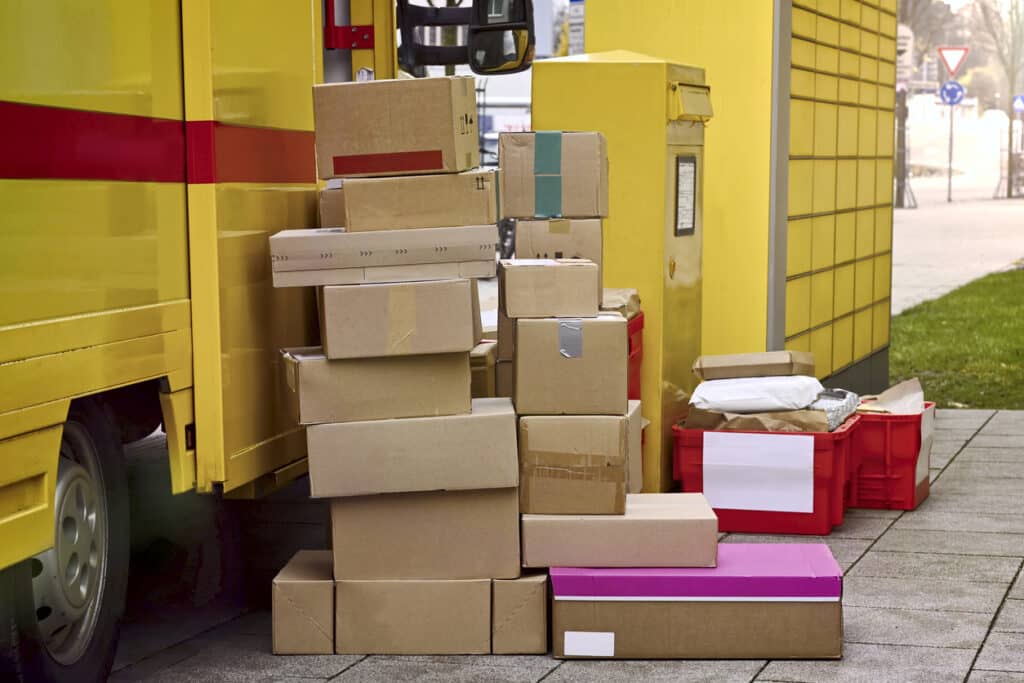
Parcels next to a German delivery van. Credit: Lightspruch
On the web
The Deutsche Post German language site is at: www.deutschepost.de
The Deutsche Post has an English language section here: www.deutschepost.de/en/home.html
For current information about the post office procedures regarding the coronavirus, visit: www.deutschepost.de/en/c/coronavirus.html
For English language information on sending and tracking packages go to www.dhl.de/en.html
This is the English site of Deutsche Post DHL Group , which is part of the German Post Office.
Now that the Deutsche Bundespost is no longer a government monopoly, its old banking part, the Postbank, is acting more like a private bank. The banking service is run by Deutsche Postbank AG. It was long a government service to the small depositor, giving him little more than an inexpensive checking or savings account. Now, however, it has gone also into mortgages, credit cards, consumer credit and the sale of insurance. The Postbank continues to maintain a presence in many post offices with service at the counters and ATM’s in many locations.
BTW: In case you are are looking to find out how to address a letter to or within Germany then we made a full article about: How to correctly address mail being sent within and to Germany.
